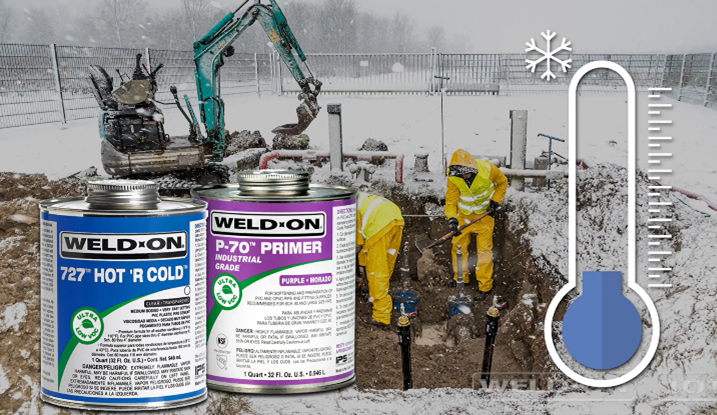
As colder weather moves in, freezing temperatures will soon be unavoidable on some jobsites. For jobs that include solvent welding plastic pipe, it’s important to consider how temperature will impact the bond strength of PVC cements and primers. Our technical team has assembled a list of best practices to help plumbing professionals achieve consistent, reliable joints even when the jobsite is freezing.
Control the environment when possible
You may not be able to control the weather, but you can control your preparation for the jobsite. Before you brave the freezing temperatures, consider pre-fabricating as much of the system as possible in a heated workspace. We also recommend storing PVC cements and primers in a warm location near the jobsite—around 70°F is ideal, but above 40°F is the standard. If your inventory of cement or primer does freeze, it can still be used. Simply place it in a heated area and allow it to thaw out naturally. Once thawed be sure to thoroughly stir or shake the can to make sure the contents are distributed evenly.
WARNING: DO NOT artificially heat up the can, such as placing in boiling water as this poses a safety hazard.
Prepare the pipe and fittings properly
The right surface preparation is even more critical in extreme weather conditions. Make sure to wipe away any moisture or frost from the pipe and fitting surfaces before priming. Any water on the PVC can prevent the cement from bonding properly.
Do what you can to keep all pipe and fittings at the same temperature to minimize expansion and contraction differences. Commercial heat blankets can help warm up pipe and fittings to workable temperatures in extremely cold conditions.
Choose the Right PVC Cement and Primer
Colder temperatures slow down the chemical reactions of the primer and cement on the surface of pipe and fittings. To ensure a successful bond, it’s important to select products that are formulated to perform in cooler conditions.
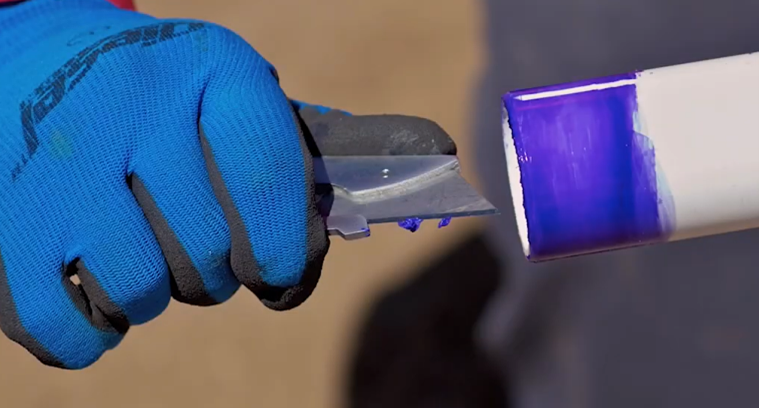 Since primers will soften the materials more slowly, you should opt for a more aggressive product such as Weld-On® P-70 Primer. During application make sure to continue applying until the surface of the pipe or fittings soften, which can be tested with a simple scrape test.
Follow up with Weld-On 727 Hot ‘R Cold Solvent Cement for a deep fusion between pipes and fittings, even at temperatures as low as -15°F.
Even when using more aggressive primers and specially formulated cements, plumbers should allow for longer set times for handling strength to develop and longer sure times before pressure testing.
As with any Weld-On solvent cement products, be sure to read all instructions on can labels to ensure proper usage.
Cold Weather Isn’t a Dealbreaker
With the right preparation and products, you can create strong, reliable solvent-welded joints in any season. Take the time to control your environment, prep your materials, and follow recommended cure times and your results will speak for themselves when the temperatures drop.
Reach out to our team of experts for more tips to keep your jobs moving all year long.